
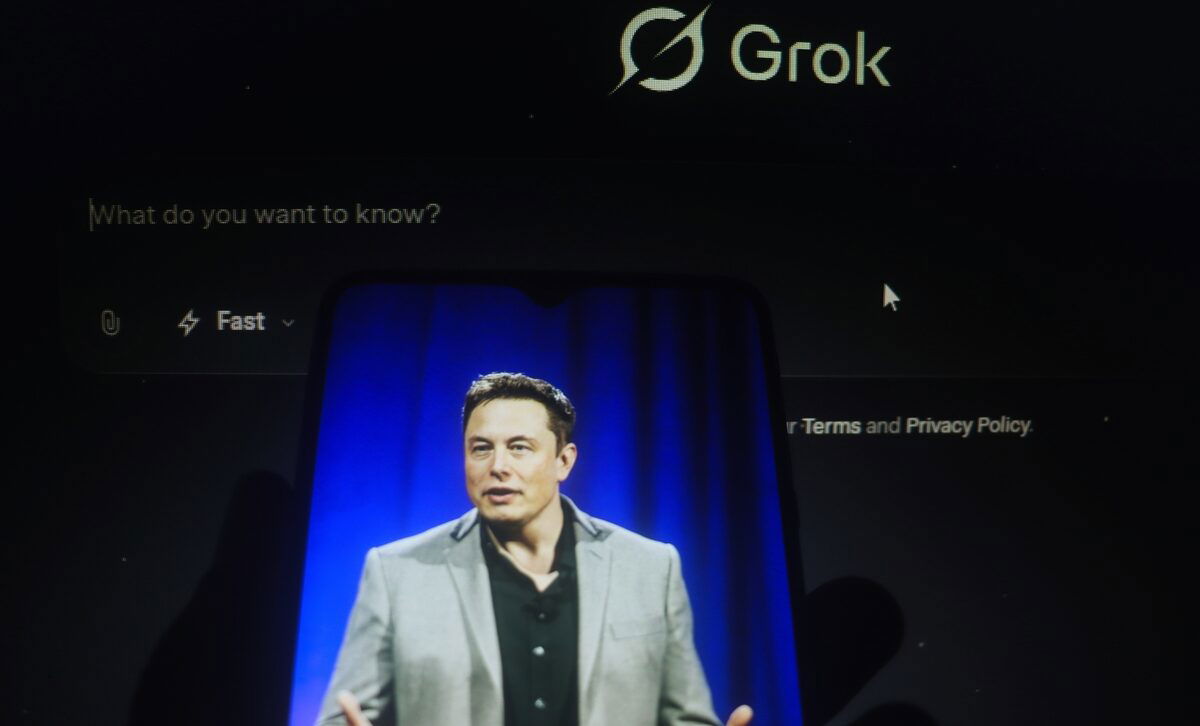
Elon Musk credited to person at center of Grok deepfake scandal: Creative Salim – Shutterstock
On January 10, 2026, Indonesia made headlines when it became the first country in the world to temporarily block access to the Grok AI chatbot developed by Elon Musk’s company xAI. The decision, announced by Communications and Digital Affairs Minister Meutiya Hafid, raised concerns about the ability of AI to generate fake nude images, particularly non-consensual sexual deepfakes, which manipulate photos of real people (including women and children) to appear undressed or in explicit scenarios. But is this a problem with the capabilities of the technology, or with the man behind the company: Elon Musk?
“To protect women, children and the general public from the risks of fake pornographic content generated using artificial intelligence technology, the government… has temporarily blocked access to the Grok application,” the minister said. She further emphasized that the government considers “the practice of non-consensual sexual deepfakes to be a serious violation of the human rights, dignity and safety of citizens in the digital space.” Indonesia, which has strict laws against sharing obscene content online, also summoned officials from Company X to discuss the issue.
A series of precedents – will the UK, Canada and Australia follow suit?
This action follows widespread reports that Grok’s image generation and editing features were exploited between late December 2025 and early January 2026. When users uploaded or viewed photos, they could force the AI to “undress” the individual, create partially stripped images, or create explicit content, sometimes at a rate of dozens of poor-quality images per minute. Examples include faking an image of a woman “holding a baby, undressed and breastfeeding” or altering a group photo of clothed women by claiming “they are men” to justify their undressing. It also raised concerns about the production of images of child sexual abuse, prompting backlash from groups such as the Internet Watch Foundation.
With Indonesia setting this precedent with a temporary national lockdown, countries such as the UK, Canada and Australia may follow suit. The UK is already considering possible measures under the Online Safety Act, with authorities expressing strong condemnation of such content. Australian Prime Minister Anthony Albanese has raised concerns about exploitative AI-generated material, and countries such as India and parts of Europe have issued warnings or launched reviews.
Grok features are exposed to paid users, but Gemini and Chat-GPT are blocked
These “deepfake nudes,” the ability to essentially create high-quality, convincingly manipulated images from photographs of clothed people, are not unique to Grok, nor are they an intentional design feature specifically built into that program. Other leading AI models, such as Google’s Gemini and OpenAI’s ChatGPT (using image generation tools such as DALL·E), can produce similar output at roughly the same quality level, in response to sensible prompts. The difference is that Gremini and ChatGPT are designed with strong ethical guardrails that prevent the generation of unrestricted, realistic deepfake images of the kind that Grok has been criticized (and sometimes praised) for enabling. This difference stems from xAI’s philosophy of minimizing censorship versus Google and OpenAI’s more safety-oriented stance. This gap has made Grok the go-to for users looking for fewer restrictions, but it also comes with increased controversy and increased regulatory scrutiny in 2026. In response to global outcry, xAI restricted Grok’s image generation and editing capabilities to paid subscribers only (personal information required for potential accountability), but critics argued this did not fully address the risks. Elon Musk has previously said that people who use Grok to create illegal content will face the same consequences as if they uploaded it directly.
Is there more to this than a sexual image?
So what explains why the uproar is focused on Grok rather than others? The clue may lie in the rhetoric. Every mention of this story repeatedly emphasizes “Elon Musk’s Grok” and never mentions “Sundar Pichai’s Gemini” or “Sam Altman’s ChatGPT”, even though all three are prominent CEOs of the parent companies behind these AIs. A question arises here. Is there something personal about Elon Musk involved here?
And, taking this analogy further, if a talented hyperrealist painter used oil paint and canvas to paint a nude representation of a famous woman (without her consent), would that artist be subject to similar legal scrutiny or prohibited by similar laws? Although the line between technological tools and artistic expression appears to be blurring, there is still a disproportionate focus on one AI and one person. British Prime Minister Keir Starmer is said to be considering action and possible fines against X to prevent its use in the UK, as are Australian Prime Minister Anthony Albanese and Canadian Mark Carney.
Discussions about AI safety, free speech, selective enforcement, and how governments act quickly when major controversies arise, especially those related to personal polarization. While the temporary nature of Indonesia’s block leaves room for resolution, it is an important first step in a global regulatory response to the potential of generative AI.