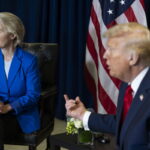


President Donald Trump and President Volodymyr Zelenskiy meet as talks continue on a possible peace deal with Ukraine. Credit: Joshua Sukoff, Shutterstock
Donald Trump’s message was upbeat, almost confident. The US president, standing next to Ukrainian President Volodymyr Zelenskiy in Florida on Sunday, December 28, said the two countries are now “very close, perhaps very close” to a deal that could end the war in Ukraine.
But even as President Trump talked about progress, he made it clear that some of the toughest questions remain unanswered. The most important of these is what will happen to eastern Ukraine, especially the disputed region of Donbas.
The two leaders met after a meeting at Trump’s Mar-a-Lago resort to discuss what Trump described as the two most sensitive issues in the talks: Ukraine’s security and moves by Russia over the future of the territory since the war began.
Further advances in security assurance
Regarding security, the two leaders took a cautious but positive stance.
Zelenskiy said an agreement had been reached on guarantees to protect Ukraine after the end of the war, which he called an important milestone. President Trump was more modest, saying talks were about “95%” complete and stressing that Europe was expected to take on much of the responsibility, with U.S. support rather than direct guidance.
There were no details on what those guarantees would actually be, a silence that reflects the sensitivity of the issue as it remains. Russia has repeatedly said it will not accept the presence of foreign troops in Ukraine, which complicates long-term security agreements.
French President Emmanuel Macron said after the meeting that progress had indeed been made. In a post on X, he confirmed that member states of the so-called “coalition of the willing” will meet in Paris in early January to finalize what he called “concrete contributions.”
Donbas remains the biggest obstacle
When security is moving forward, territory is where negotiations stall.
Mr. Trump and Mr. Zelensky acknowledged that the future of the Donbass family remains unresolved. Russia wants complete control of the region, but Ukraine has made clear it wants any deal that reflects current fronts rather than giving up land held by its military.
President Zelenskiy has previously said he wants to soften a U.S.-backed proposal for Ukrainian forces to completely withdraw from Donbas, a move Kiev considers unacceptable.
President Trump said Sunday that discussions about the region are “moving in the right direction” but acknowledged it remains a “very difficult issue.” The United States has floated the idea of creating a free economic zone if Ukraine leaves the region, but how that would work remains unclear.
President Trump clearly stated, “It’s unresolved.” “But it’s coming.”
Zelenskiy also stressed that any peace agreement would need approval within Ukraine, either through parliament or a referendum. President Trump said he was willing to speak directly with Ukrainian lawmakers if it would help bring about a deal.
President Trump meets President Putin for the first time
Just before Zelensky arrived in Florida, Trump had a lengthy phone conversation with Russian President Vladimir Putin, adding a new element to the day’s diplomacy.
President Trump said the two sides spoke for more than two hours and said the conversation was productive. The Kremlin struck a similarly positive note, with adviser Yuri Ushakov calling it friendly.
Mr. Ushakov said President Putin rejected a 60-day ceasefire proposal backed by the European Union and Ukraine, arguing that it would only prolong the conflict. He also said Ukraine needed to take a decision on Donbass “without further delay.”
President Trump said that President Putin has expressed his intention to help rebuild Ukraine after the war, including by providing low-cost energy supplies. “Russia wants to see Ukraine succeed,” Trump said, adding, “That sounds a little strange.”
As Trump praised Putin, Zelensky could be seen tilting his head and smiling, a moment that captured the awkward balance of the meeting.
The Kremlin then publicly supported Trump’s mediation. Kirill Dmitriev, Putin’s special envoy, wrote to X that Trump’s peace efforts are highly praised around the world.
Nuclear power talks as fighting continues
Negotiators are also discussing the Zaporizhzhia nuclear power plant, which remains under Russian control. President Trump said progress had been made, calling the fact that the facility was not bombed a “huge step” and suggesting the facility could be reopened soon.
The International Atomic Energy Agency confirmed that repairs to power lines had begun after a ceasefire on the ground.
All of this happens as fighting continues on the ground. The day before Zelenskiy’s visit, the Russian military fired hundreds of missiles and drones into Kiev and other cities and cut off electricity and heating in parts of the capital.
President Zelenskiy described the attack as Russia’s response to U.S.-backed peace efforts. But Trump said he believed both Putin and Zelensky were serious about ending the war.
European leaders participated in part of Sunday’s talks by phone. European Commission President Ursula von der Leyen said Europe stands ready to continue cooperating with Ukraine and the United States, stressing that strong security is essential.
British Prime Minister Keir Starmer’s spokesman echoed similar views, stressing the urgency to end what he called a “savage war”.
For now, there is hope for the language. Meetings are held frequently. But until land and long-term security issues are resolved, it remains difficult to gauge the distance from a peace deal that is “very close.”