
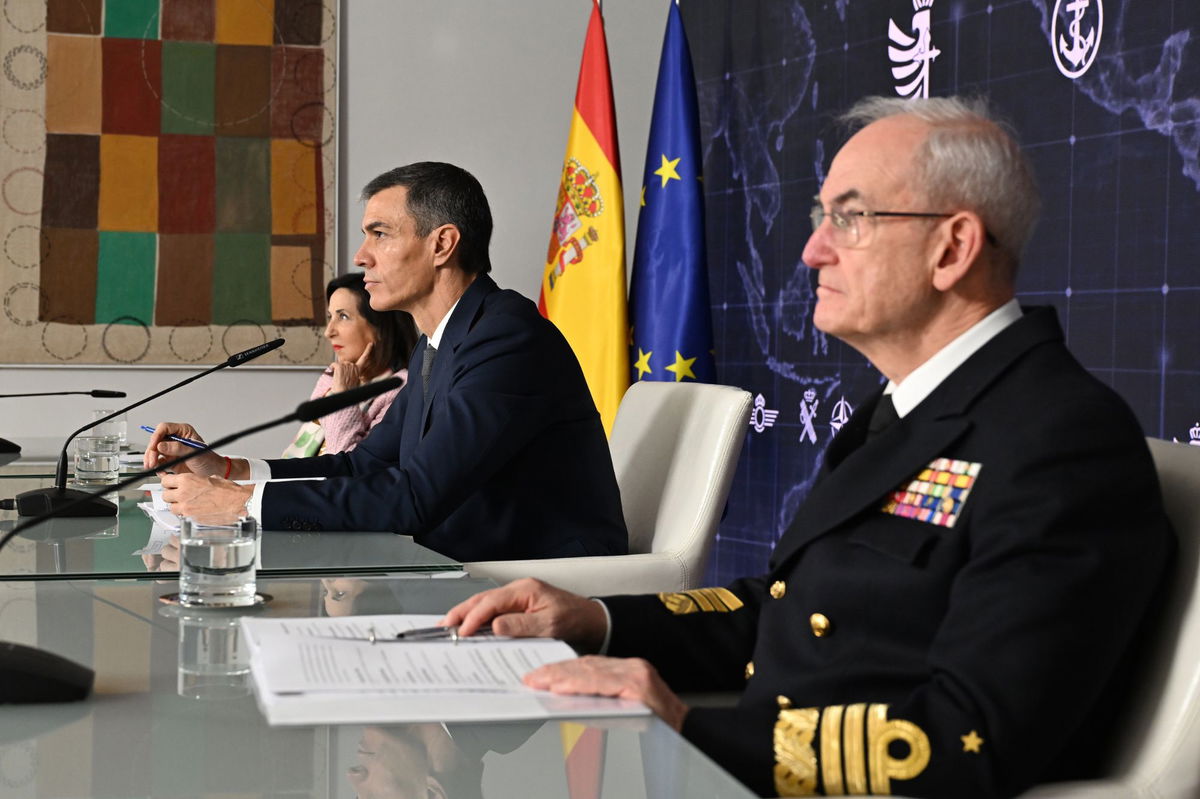
Prime Minister Pedro Sanchez during a video conference with foreign missions. Credit: Pool Moncloa/Borja Puig de la Bellacasa
Spanish Prime Minister Pedro Sánchez on Saturday (January 3) called for restraint and respect for international law following the overnight US attack on Venezuela, even as governments in Latin America and elsewhere warned of the risk of regional escalation.
Sánchez said the Spanish government was “closely monitoring developments in Venezuela” and confirmed that the Spanish embassy and consulate in the country remained operational. He called on all parties to act responsibly and respect the principles of international law and the United Nations Charter.
Political reaction within Spain
“We call for de-escalation and accountability. International law must be respected,” the prime minister said, emphasizing the need to avoid further instability.
Opposition leader Alberto Nuñez Feijo also reacted to the airstrike, calling it a “bad day” for President Nicolás Maduro’s government and its allies, including countries under the influence of the Spanish government.
Feijo criticizes Maduro and his allies
Writing in X, the Popular Party leader said that prudence is “compatible with the hope” that Venezuela can regain the future it claims has been robbed “by the complicit silence of too many of our country’s leaders.”
Feijo’s comments highlighted deep political rifts within Spain over the response to the escalating Venezuelan crisis and the role of international actors.
Russia warns of regional escalation
Russia strongly condemned what it called an “act of armed aggression” by the United States against the Bolivarian Republic of Venezuela.
In a statement released hours after reports of bombings in Caracas and several Venezuelan states, Moscow warned of the risk of broader regional escalation and stressed that “Latin America must remain a zone of peace,” referring to commitments made by the Community of Latin American and Caribbean States in 2014.
Defending Venezuela’s sovereignty
Russia’s Foreign Ministry said Venezuela must be guaranteed the right to decide its own fate “without any destructive interference, much less without external military interference.”
It also denied the U.S. government’s legitimacy for the intervention, arguing that ideological hostility outweighed practical considerations.
Colombia activates safety measures
In Colombia, President Gustavo Petro announced the creation of a National Security Council and the deployment of official forces along the country’s shared border with Venezuela.
Mr. Petro called the U.S. actions an invasion of Venezuela’s sovereignty and said Colombia, which currently serves as a non-permanent member of the U.N. Security Council, would call for the U.N. Security Council to convene to deal with the crisis.
Call for dialogue and civil protection
“The Colombian government rejects any invasion of Venezuela’s sovereignty,” Petro said, calling for dialogue and unity among the Venezuelan people and reaffirming the United Nations principle of self-determination.
He expressed “deep concern” over reports of explosions and unusual air activity and rejected “any unilateral military action” that could endanger civilians.
Mexico condemns unilateral military action
Mexico’s Ministry of Foreign Affairs issued a strong statement condemning the United States’ unilateral military action against targets in Venezuela.
The Mexican government called the attack a serious violation of Article 2 of the United Nations Charter and reiterated its commitment to international law and a pacifist foreign policy.
Urgent call to cease hostilities
Mexico warned of serious consequences for regional stability and called for an immediate end to all acts of aggression against the Venezuelan government and people.
The statement reflects growing concern across Latin America over the precedent set by military intervention.
Iran joins international criticism
Iran also joined the chorus of condemnation, with the Ministry of Foreign Affairs condemning the US attack on Venezuelan territory as a clear violation of the United Nations Charter and basic norms of international law.
Tehran specifically referred to the prohibition on the use of force and asserted that this action was a threat to international peace and security.
Pressure mount for de-escalation
Iran called on the United Nations and governments, which uphold the rule of law, to “immediately and unequivocally” condemn the attack.
The flurry of reactions has increased international pressure for de-escalation and diplomatic engagement to prevent further destabilization of Venezuela and the wider region.