

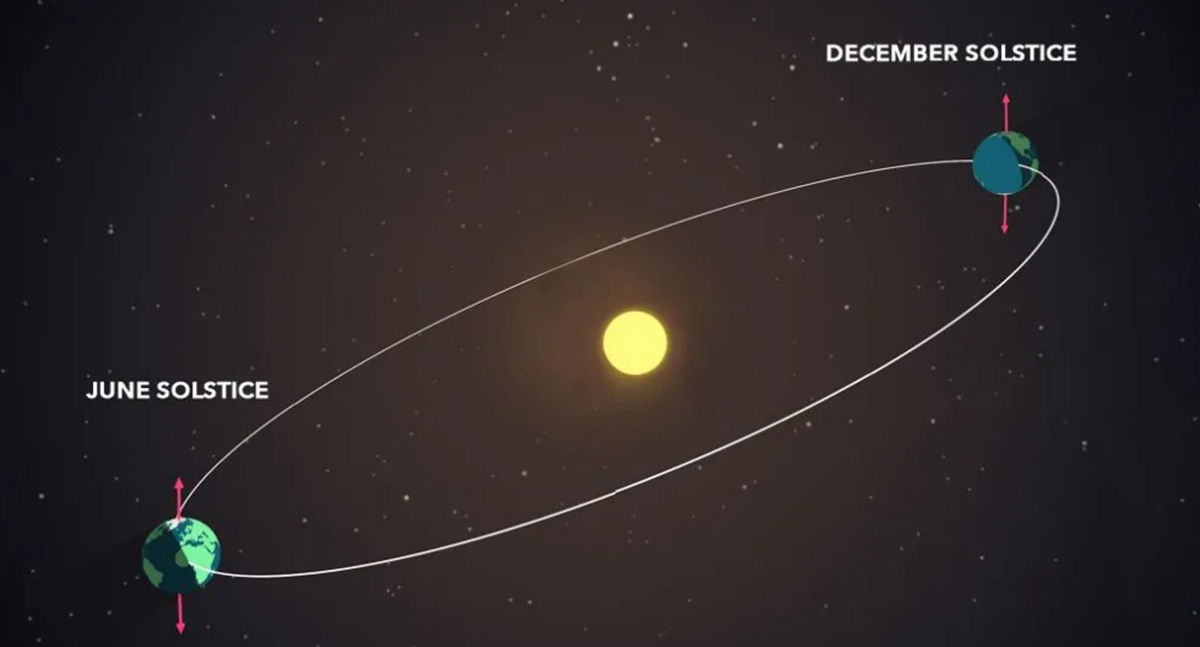
A diagram from NASA explaining the winter solstice and the Earth’s tilt. Credit: www.nasa.gov
On Sunday, December 21st, the world will mark the winter solstice. The winter solstice is the shortest day of the year for everyone living in the Northern Hemisphere. This is the day when daylight disappears earlier than at any other point on the calendar, extending the night a little longer than usual. For many, it comes quietly. It’s the familiar winter feeling of dark mornings, early sunsets, and little time left before the day begins.
In the UK, the summer solstice occurs at around 3:03 p.m. It will arrive in New York at 10:03 a.m., Los Angeles at 7:03 a.m., Central Europe, including Spain, after 4 p.m., and India late in the evening at 8:33 p.m. The moment itself is invisible – there are no flashes or sounds – but from that very point, something reassuring begins to happen. Every day will be a little brighter than before.
Why is December 21st the darkest day of the year?
The science behind the summer solstice is simple, but its effects are dramatic. The Earth is tilted on its axis, and the Northern Hemisphere is farther from the Sun during December than at any other time of the year. This moves the sun lower in the sky and reduces daylight hours to a minimum.
Cities like London, Toronto, and New York will notice unusually short days, with daylight hours limited to just a few hours. Further north, in parts of the Arctic Circle, the sun never appears, leaving communities in near-continuous darkness.
According to NASA, seasonal changes have nothing to do with how close the Earth is to the sun, but are entirely related to this tilt. As the planet continues its orbit, its angle slowly changes again, and by December 22, sunlight begins to creep into the Northern Hemisphere.
In the southern hemisphere, it’s a completely different story. Countries such as Australia, New Zealand and Chile experience the longest days of the year in summer, and the depths of summer while northern regions experience the deepest winter.
Moments that humans have been recording for thousands of years
Long before modern timekeeping, early civilizations carefully observed the skies and erected monuments to mark the summer solstice. Some of Europe’s most famous places were designed with this very moment in mind.
At Stonehenge in England, the stones are lined up in time for the winter sunrise. Meanwhile, in Newgrange, Ireland, on the morning of the summer solstice, sunlight filters through narrow passageways and illuminates ancient chambers built more than 5,000 years ago. These structures show how people once lived deeply in tune with the earth’s natural cycles. The return of light is used to mark both survival and rebirth.
Today, space agencies monitor Earth’s movements with pinpoint precision, but the summer solstice still carries emotional weight far beyond scientific data.
How the shortest day affects our mood
The latest research suggests that a lack of sunlight during the winter months can be damaging. Mental health experts often point to higher rates of seasonal affective disorder (SAD) during the dark months, when people report low mood, fatigue, and disrupted sleep patterns.
Experts advise making the most of natural light, staying socially connected and maintaining regular sleep habits during the winter months, as well as taking short walks outdoors. For some people, light therapy has become a popular option to combat the emotional effects of long, dark days.
However, despite its reputation, the winter solstice is not something that many people fear. For others, it feels strangely comforting.
There is something about knowing that this is the deepest part of winter, the longest night we face, and a turning point. From December 22nd, sunrise will arrive a little earlier than the last. At first, it is almost impossible to notice the change. A few seconds are important before the minutes are displayed.
As the weeks go by, the mornings become brighter. The afternoon will be a little longer. Slowly and steadily the light returns.
As the debate about protecting our planet grows louder, moments like the summer solstice remind us of how closely human life is tied to Earth’s natural patterns. No matter how modern we become, we still feel the changing seasons.
This Sunday, December 21st, marks the darkest day of the year. Yes, but it’s also a quiet promise that brighter days are already on the horizon.