

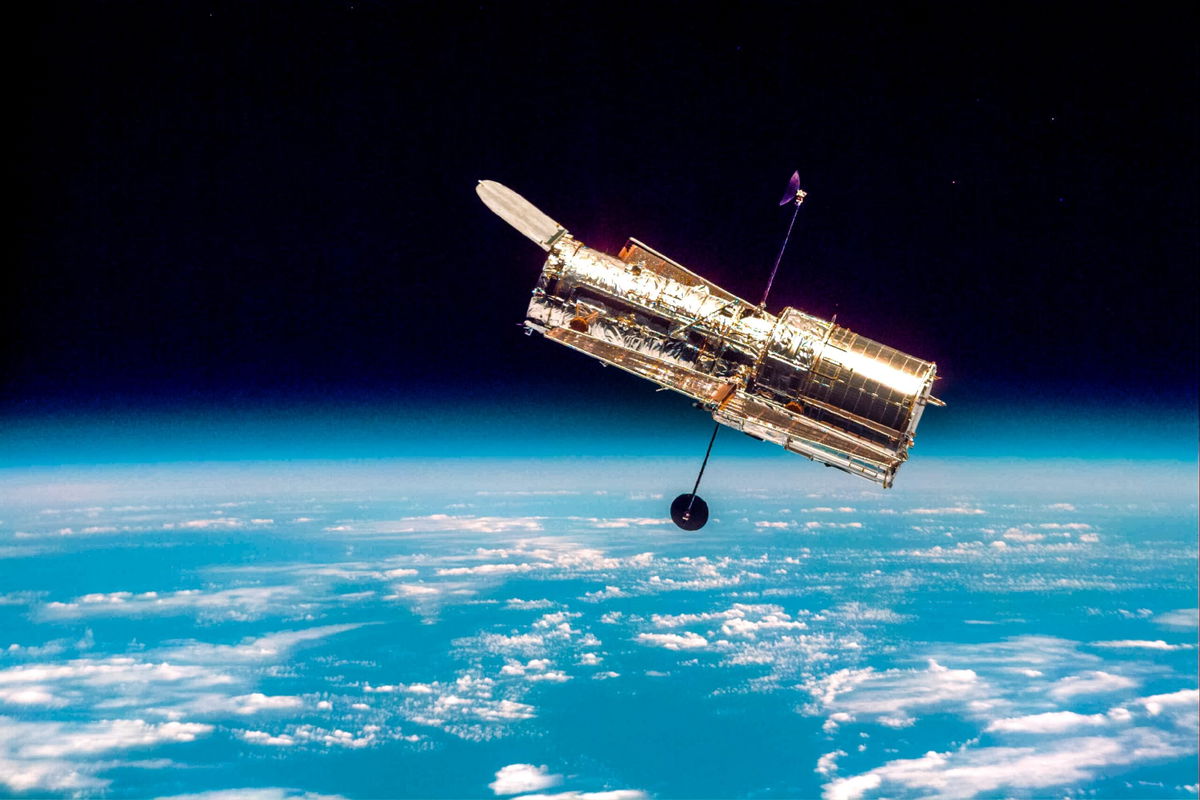
Analyzes predict that Hubble’s uncontrolled reentry could occur as early as the late 2020s. Photo credit: Rawpixel.com/Shutterstock
The Hubble Space Telescope, one of the most productive scientific observatories ever launched, is on a gradual but inevitable downward spiral toward Earth due to atmospheric drag acting in low Earth orbit. Launched in 1990, Hubble’s orbit at an altitude of about 540 to 560 km slowly decays as its altitude decreases over time due to drag in the thin upper atmosphere. Failure to take corrective action will ultimately lead to re-entry into Earth’s atmosphere.
The telescope was periodically raised to high orbit during maintenance missions by Space Shuttle crews between 1993 and 2009. Since the retirement of the shuttle fleet, such opportunities have disappeared, leaving Hubble’s orbit unchecked. Without an active boost or controlled deorbit mission, the telescope will continue to descend as atmospheric drag gradually reduces its orbital speed.
Reentry predictions vary
Model predicting reentry by 2030s
Analyzes predict that Hubble’s uncontrolled reentry could occur as early as the late 2020s to mid-2030s. Solar activity plays a key role in determining the rate of orbital collapse, as increased solar radiation heats and expands the upper atmosphere, increasing drag on satellites at Hubble altitude. Although this variation creates uncertainty in estimating the exact timing of reentry, the long-term downward trend is still evident.
Risk posed by uncontrolled descent
Debris and safety considerations
Hubble was not designed for uncontrolled reentry. If the telescope were to re-enter without a controlled deorbit plan, most of its structure would burn up upon atmospheric entry, but some larger components might survive and reach the ground. Experts say it is unlikely, but not zero, that the debris will affect populated areas, as re-entry from a disintegration trajectory could scatter surviving debris over a wide geographical area.
Space agencies typically plan controlled deorbits of large spacecraft to guide surviving debris to uninhabited areas, such as remote ocean areas, to minimize risk. A docking adapter installed during Hubble’s last maintenance mission in 2009 could facilitate future controlled reentries, but no missions are planned to use it.
Potential mitigation efforts
NASA and private sector proposals will be considered
In response to the collapse issue, NASA and SpaceX have been considering options to extend Hubble’s operational life or enable safer end-of-life scenarios. One concept being discussed involves a private sector mission that could rendezvous with Hubble to accelerate its orbit, postpone reentry, and allow for a controlled deorbit after mission completion.
Such proposals are still in the planning or research stages, and none have been formally adopted as of early 2026. If a reboost mission were pursued, it could significantly delay the telescope’s descent and reduce the risks associated with uncontrolled reentry.
Important points
- Hubble’s orbit gradually decays due to atmospheric resistance.
- Re-entry is expected to occur from the late 2020s to the mid-2030s.
- Most of the telescope will burn out, but some of the debris may reach the ground.
- No controlled deorbit missions are planned.
- NASA and SpaceX’s proposal to accelerate Hubble’s orbit is still in the planning stages.
Broader context for telescope reentry
Uncontrolled reentry is not unique to Hubble
Many satellites and spacecraft in low Earth orbit eventually reenter the atmosphere uncontrolled, unless they are actively removed from orbit. Space agencies typically aim to mitigate these risks through design, end-of-life planning, and controlled deorbit missions, but the scale and scientific value of assets like Hubble complicate planning for final disposal strategies.
Hubble continues to make valuable scientific observations while engineering teams monitor its health and plan for its eventual retirement.