
Creator( )Karl-Heinz Paquet, Chairman of the Board of the Friedrich Naumann Free Foundation
Release date
The opinions expressed in this article are those of the author and do not in any way represent the editorial position of Euronews.
It was a picture of misery and humiliation for the European Union. At the end of July 2025, Ursula von der Leyen and Donald Trump announced the outcome of the so-called tariff negotiations in Scotland, namely Washington’s 15% tariff.
In return, Europe promised huge investments in the United States, but only as a guarantee that President Trump’s threat to impose even higher obligations would not be carried out.
In other words, it was pure blackmail and no real negotiation on equal terms. Further setbacks may now be on the horizon for Europe.
One good example is the Greenland issue. In defiance of international law, President Trump blatantly threatened to annex or purchase the vast island or lure Greenlanders with generous economic incentives that Denmark could not match.
Europe has responded with angry calls for unity against the United States under the Trump administration. But it takes little imagination to foresee that if the United States simply creates a fait accompli in Greenland and flies the Stars and Stripes over the island’s ice, the EU’s NATO allies may ultimately fail to act, despite their formal obligations to protect Denmark.
There will undoubtedly be mass protests, but the Europeans will not provoke a war within NATO over such an incident.
The core issue is straightforward. Europe’s NATO members lack the ability to deter a unilateral act of U.S. aggression through a credible threat in advance, let alone reverse it after the fact with a military response.
The same applies in the field of economics. If the EU threatens the US with a violent trade war, the US could at any time call into question NATO’s security, which could have a devastating effect on European security vis-à-vis Putin’s Russia.
In such cases, Europe’s overall economic strength is of little use. Because, ultimately, security is more important than trade. In other words, Europe remains permanently vulnerable to extortion.
The reason is the imbalance of military power across the Atlantic, resulting from decades of underinvestment in defense capabilities by European countries. This was acceptable for Europe as long as trust in its ally, Washington, remained stable and high.
President Trump has destroyed that credibility in an astonishingly short amount of time, although this is a historic “accomplishment” of his second term.
He decisively ended the postwar era that began in 1946 with the Cold War.
He returned to the traditional 19th century philosophy of American foreign and security policy, the infamous Monroe Doctrine.
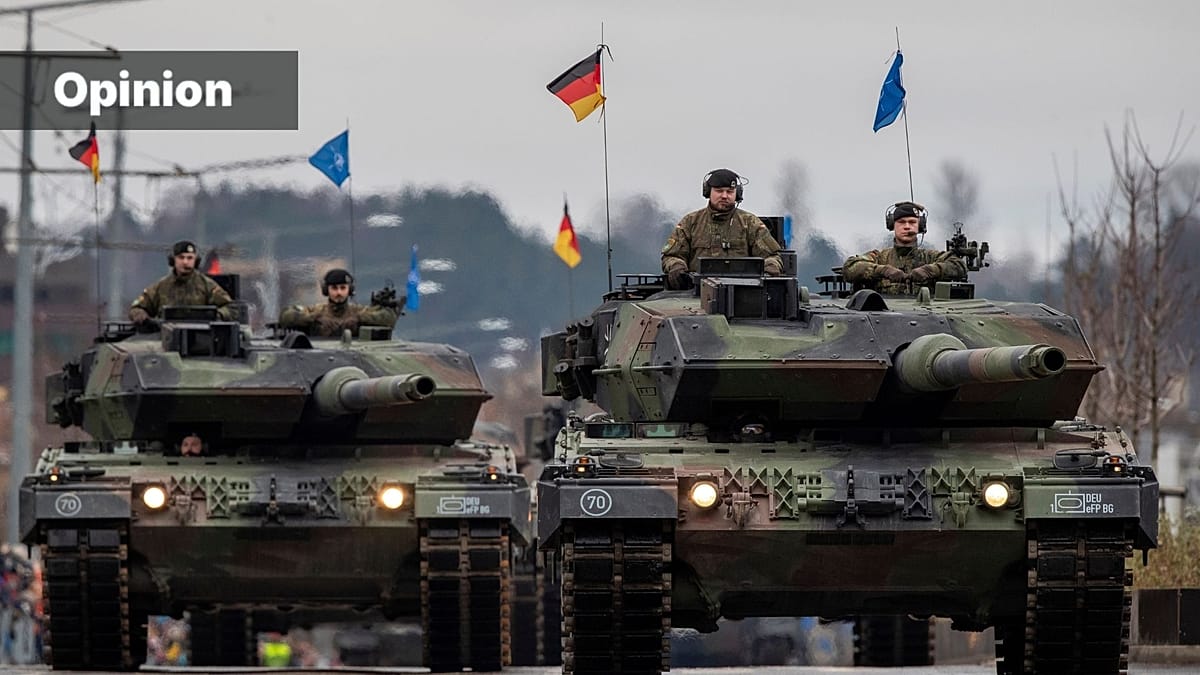
It is therefore clear that Europe can no longer rely on the United States, even within NATO. The only consequence is this: Europe must rearm on a large scale.
The 5% of GDP threshold for defense spending agreed at the 2025 NATO summit is an important step in the right direction.
Harbor has no illusions
The gap with the US will remain huge for years, if not decades, simply because the huge investment balances have been accumulating for at least 30 years.
Furthermore, in the nuclear field, it is not yet clear how this gap can be politically bridged. There are also economic bottlenecks.
First, the European defense market, unlike the US defense market, is still far from integrated. As a result, the classical advantages of the division of labor in weapons production have not yet been realized.
This, too, was the result of a lack of trust, this time among the European partners themselves, who did not want to depend on each other and instead pursued narrow technological self-interest. This has to change.
Second, Europe, and Germany in particular, suffers from a potential competitive disadvantage. Europe’s economic growth is systematically slower than that of the United States, making it socially and politically more difficult than ever to extract the resources that must be set aside for defense.
It is much more difficult to divert 5% of a stagnant GDP to consumption than it is to divert 5% from a dynamically growing economy.
For this reason, drastic economic reforms are urgently needed in Europe, especially Germany, to achieve military objectives.
I can’t go back now
Europe is facing its most serious political challenge in decades. The credit for this goes to Trump.
But Europeans should not complain. Under Trump’s predecessor, and during his first term, they casually ignored the clearly visible hardening of Washington’s positions.
As a result, they now face particularly high prices. Whether they are willing and able to pay for it remains to be seen. The future provides the answer – and that future begins in 2026.
We are at a tipping point. And there’s no going back.
Karl-Heinz Paquet is Chairman of the Board of the Friedrich Naumann Free Foundation and President of the Liberal International.