
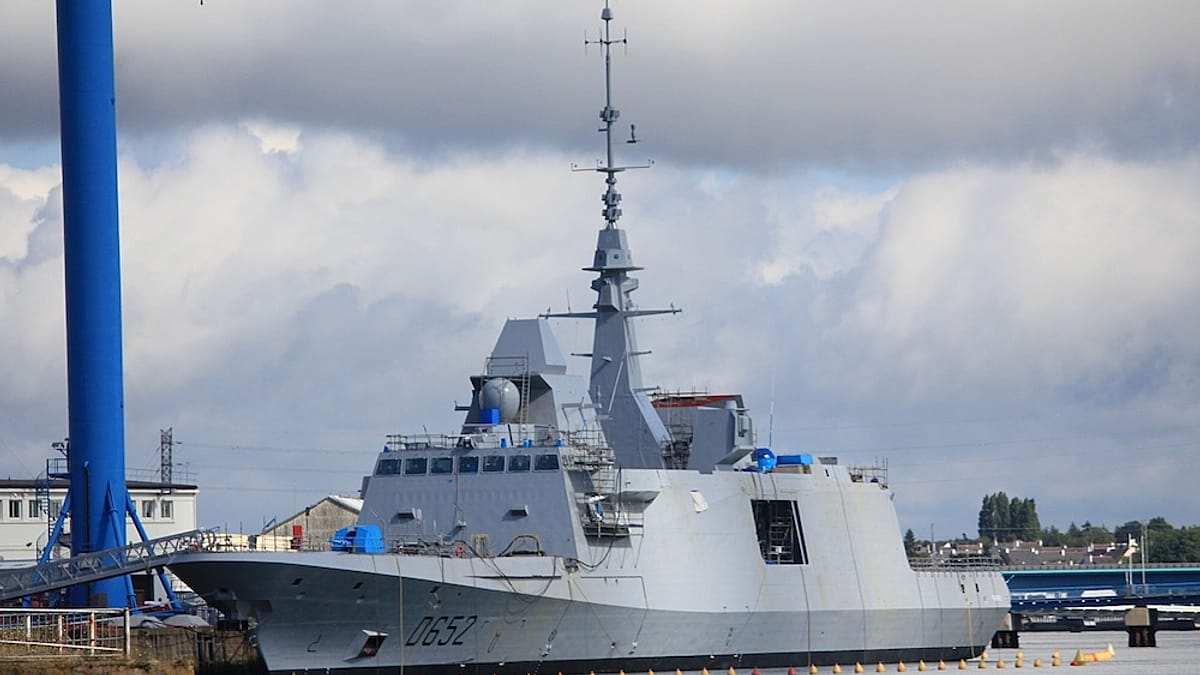
Italian shipbuilder Fincantieri has secured a $3 billion amended contract with the U.S. Navy, including about $1 billion in compensation, after its original 2020 contract for 10 frigates was reduced to just two ships.
The date change, announced on November 26, comes ahead of a meeting of EU Foreign Affairs Council defense ministers in Brussels on Monday, where military aid and defense preparedness for Ukraine will be discussed.
Under the revised agreement, two Constellation-class frigates already under construction would be completed, but four additional ships previously in service would be canceled. The remaining ships will be replaced by smaller ships, both manned and unmanned, for amphibious operations, special missions, and surface combat.
According to the US trade magazine The War Zone, the two frigates under construction are still only 10% complete, two years after construction began and five years after the contract was signed.
Fincantieri’s press office told Euronews that the new order is worth about $2 billion and the compensation is about $1 billion, bringing the total amount to $3 billion.
The original contract in 2020 was worth $5.58 billion for 10 ships based on the FREMM (European Multi-Mission Frigate) design. Fincantieri won the contract over competition from Austal USA, General Dynamics, and Navantia.
However, only $795 million was immediately guaranteed, with the remainder dependent on the US Navy’s exercise of the option.
Production is conducted entirely in the United States by Fincantieri Marinette Marine, a Fincantieri subsidiary based in Wisconsin. The company currently employs 3,750 highly skilled employees in the United States, an increase of 850 people recently.
Fincantieri acquired Marinette Marine from US-based Manitowoc Marine Group in August 2008 for 120 million euros.
The Italian government holds 71.32% of Fincantieri’s shares through Cassa Depositi e Prestiti.
Economic benefits for Italy are limited
Francesco Vignarca, campaign coordinator for the Italian Network for Peace and Disarmament, said the economic benefit to Italy is negligible due to the fact that production is entirely in the United States.
“The workers employed are and will continue to be American, with the exception of a foreseeable portion of taxes paid to the Italian state when Fincantieri’s balance sheets are consolidated,” Vignarka said. “Specifically, from a marketing perspective, our country will only get a fraction of the billions of dollars.”
Fincantieri told Euronews that orders often include additional benefits beyond just ship construction, such as service, maintenance and training.
The company also pointed out that in the case of shipbuilding, the government, like the Italian Navy, is involved and may impose restrictions based on national interests. Fincantieri said the shipbuilding industry is “blessed” compared to other shipbuilding industries because of the high level of European technology and design content.
Questions about European defense strategy
The deal casts doubt on Europe’s defense strategy as the EU pushes ahead with the rearmament of its member states.
“All the funds proposed by Brussels, most recently the EoIP voted on a few days ago, will do little to drive real structural adjustment of the military industry,” Vignarka said. “This has already been demonstrated in the first years of the introduction of the European Defense Fund.”
The European Defense Fund has set the threshold for European co-production at 65%. Fincantieri pointed out that this threshold accounts for the fact that some non-European components lend themselves to rapid production.
“Military production companies go where they can get the most profitable contracts,” Vignarka said.
“They pretend to pursue national and security interests, but in reality they primarily pursue maximum interests. This is why European funds, by their structure, do not work well as catalysts for dynamics towards Europe’s common defense.”
The incident is reminiscent of past cases in which European know-how has been exported to other countries, such as the Italian Agusta A129 Mangusta helicopter, which was purchased by Turkey and manufactured under license from Italian arms giant Leonardo.
Fincantieri told Euronews that the shipbuilding industry typically sells finished products rather than exporting know-how.
Cassa Depositi e Prestiti, which is 83% owned by the Economy Ministry, declined to comment, saying: “These are Fincantieri’s choices and we do not see any need to express our opinion.”