

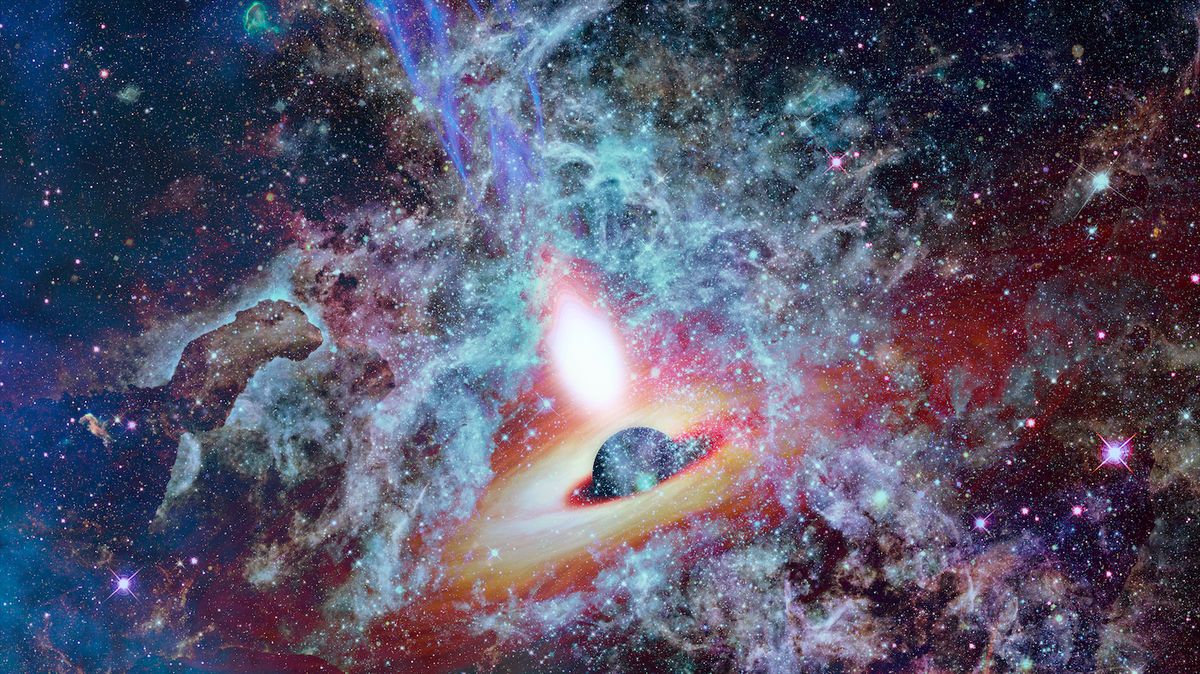
This quasar, known as APM 08279+5255, is located in a young galaxy and is driven by a supermassive black hole that emits intense radiation. Photo credit: Nasa Images/Shutterstock
Astronomers have identified a giant cloud of water vapor surrounding a distant quasar, indicating it is the largest single reservoir of water ever detected in the universe. This discovery reveals the existence of a region around a supermassive black hole located approximately 12 billion light-years from Earth that contains a volume approximately 140 trillion times the volume of Earth’s entire ocean.
This quasar, known as APM 08279+5255, is located in a young galaxy and is driven by a supermassive black hole that emits intense radiation. Water vapor observations were made using a combination of space telescopes and ground-based observatories, allowing astronomers to measure both the amount of water present and its extent over hundreds of light years.
What is a quasar?
Quasars are among the brightest and most energetic objects in the universe. At the center of the galaxy, a supermassive black hole pulls in gas and dust to form an accretion disk. Friction and gravitational energy cause the disk to become very hot, emitting large amounts of light, X-rays, and other radiation.
Quasars can shine brighter than the light of all the stars in their host galaxy combined and can be seen over billions of light-years away. They are commonly found in young and distant galaxies, providing astronomers with insight into the early Universe and galaxy formation. In the case of APM 08279+5255, the intense energy from the quasar illuminates and heats the surrounding gas, allowing scientists to detect spectral signatures of water vapor far from space.
Evidence of water in the early universe
water in the early universe
This detection indicates that water was present in the early universe, about 1.5 billion years after the Big Bang. Scientists say the existence of such a huge galactic reservoir far from Earth indicates that water components, including hydrogen and oxygen, were abundant and widespread even during the early years of the universe.
The discovery supports the idea that water has been a common component of galaxies since early in the history of the universe, and may have played a role in shaping their growth and evolution. This water exists not in ocean or liquid form but as vapor dispersed in the gas surrounding the quasar, but the scale is unprecedented.
scientific methodology
History of discovery
Astronomers detected water using spectroscopy, a technique that analyzes the light emitted or absorbed by atoms and molecules. Water vapor signatures were identified at far-infrared and submillimeter wavelengths, allowing researchers to estimate the total water content and physical state of the gas.
The study, led by a team at the California Institute of Technology (Caltech) and NASA’s Jet Propulsion Laboratory, combines observations with instruments that can detect distant, faint signals from early galaxies. The measurement of water vapor around APM 08279+5255 represents an important technical achievement, as the quasar’s extreme distance and brightness can easily obscure surrounding material.
Suggestions for understanding the universe
By revealing the presence of such huge amounts of water in the early Universe, this discovery will help scientists understand how galaxies formed and evolved. Water is a key molecule in interstellar chemistry and contributes to the formation of stars and planetary systems. Studying these reservoirs may provide clues to how the elements essential to life were distributed throughout the universe.
Although this water exists in the form of gas rather than oceans, comparisons with the total volume of Earth’s oceans help convey the enormous scale of cosmic structure and the possibility of similar water-rich environments in other galaxies.
Key points of discovery
- Astronomers detect the largest known reservoir around quasar APM 08279+5255
- Clouds contain approximately 140 trillion times more water than Earth’s oceans
- Water exists as vapor dispersed over hundreds of light years within the galaxy
- This discovery indicates that water existed in the early universe, 12 billion light years away.
- Observations were performed using spectroscopy and a combination of space and ground-based telescopes.
cosmic significance
What this means for future research
This discovery provides important evidence that water has been present near the beginning of cosmic history and is a widespread component of galaxies. Scientists hope that observing more similar distant quasars will reveal more about the distribution of water in early galaxies and help refine models of galaxy formation and evolution.
The discovery also highlights the possibility of complex molecules in the early universe, raising questions about the environments that could eventually lead to habitable systems. APM 08279+5255 is not a candidate for life as we know it, but the sheer size of its reservoir is forcing scientists to reconsider how the universe’s earliest galaxies developed.
As technology advances, astronomers hope that more detailed maps of cosmic water reservoirs will provide a clearer picture of the chemical evolution of the universe and its potential to support life in the distant future.