

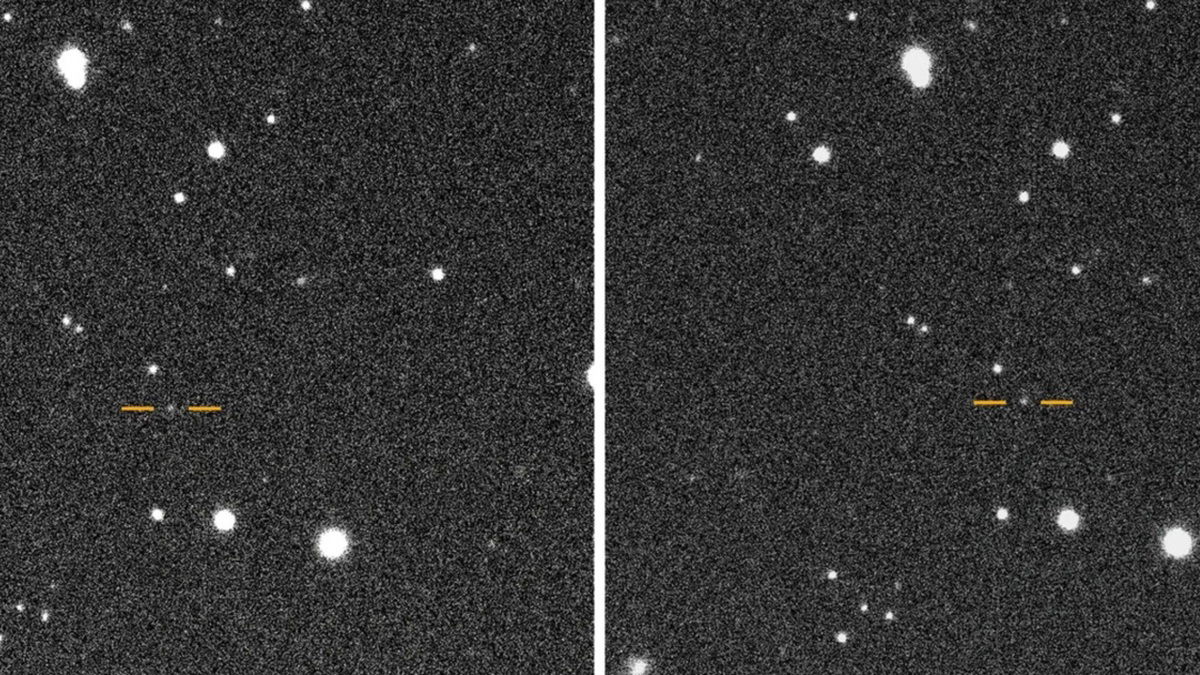
Asteroid 2025 SC79 was captured during dusk observations after hiding close to the Sun. Credit: Scott S. Sheppard /carnegiescience.edu/
It may sound almost unrealistic, but it happens more often than people imagine. A gigantic asteroid about 700 meters wide was moving silently through the inner solar system, but no one saw it coming.
It’s not because scientists haven’t looked into it. It’s not because the technology has failed. But that’s because the object was hidden in the place where the telescope would have the most trouble: in the sun’s glare.
The asteroid, now officially named 2025 SC79, was only recently discovered after slipping through a long-known observational blind spot. The discovery has already raised uncomfortable questions about how much of the space around Earth remains virtually invisible.
Discovered by chance at the edge of daylight
Most asteroid discoveries occur at night. This is when telescopes work best, scanning the dark sky for faint moving dots. However, the 2025 SC79 did not follow the rules.
It was identified by astronomer Scott S. Shepard of the Carnegie Institution for Science using a dark energy camera mounted on the Blanco 4-meter telescope in Chile. This instrument is typically used for deep space exploration, but it also has the unusual ability to operate under difficult light conditions.
On September 27, 2025, Shepard was observing through a narrow window at dusk. That awkward moment when the sun has just set below the horizon, but its light still floods the sky. In that short space of time, the two images revealed something unusual. It’s an object moving quickly across your field of vision.
It wasn’t a reflex, it wasn’t an artifact, it wasn’t a mistake.
Follow-up observations with the Gemini Observatory and the Magellan Telescope confirmed this discovery. A new asteroid has been discovered. This asteroid spent most of its time hidden simply because it was too close to the sun to be seen.
As Shepard himself has stated several times, the most dangerous asteroids are not necessarily the largest, but the most difficult to detect.
Extreme orbit closer to the Sun than Venus
What immediately set the 2025 SC79 apart was its trajectory. This is not your typical near-Earth asteroid floating between Mars and Jupiter.
Instead, it belongs to an extremely rare group known as Athira asteroids, objects whose entire orbit lies inside the orbit of Earth, in this case Venus.
Only 39 Athira asteroids are known to date. Among them, 2025 SC79 is particularly unusual. This is the second asteroid ever discovered to remain completely within the orbit of Venus.
Its speed is equally noteworthy. This asteroid orbits the sun in just 128 days, making it one of the fastest orbiting asteroids ever recorded. Only one object, 2021 PH27 (also discovered by Shepard), travels faster, completing its orbit in 113 days.
For comparison, Mercury, the planet closest to the sun, takes 88 days to complete one revolution. This shows how harsh the environment the 2025 SC79 spends is.
The asteroid’s orbit also intersects with that of Mercury, creating complex gravitational interactions that make modeling its long-term orbit difficult. These forces, combined with intense solar heat and radiation, make continued observation difficult.
Simply put, it’s fast, hot, and difficult to track.
Should I worry? Not right now, but the warning is real
At about 700 meters in diameter, 2025 SC79 is not earth-shattering. It’s nowhere near the size of the 10-kilometer-diameter asteroid that wiped out the dinosaurs.
However, it is still large enough to cause catastrophic regional damage if it were to collide with Earth. An impact of this magnitude could devastate entire regions and have severe climate impacts.
Fortunately, there is no immediate risk. Current calculations indicate there is no risk of a collision with Earth.
The unpleasant part is what the discovery revealed.
An asteroid of this size existed, moved rapidly through the inner solar system, and remained completely undetected for not days or weeks, but perhaps decades, simply because it remained close to the sun’s glare.
This is not a failure of astronomy. That is the limit of physics and observation.
Most telescopes can’t view safely or effectively when it’s too close to the Sun. As a result, dawn and dusk remain some of the least explored regions of near-Earth space.
NASA-backed detection programs, including those using dark energy cameras, are now increasingly focused on these overlooked zones. The findings in 2025 SC79 strengthen the case for doing so.
More than just a threat: A treasure trove of science
Beyond planetary defense, 2025 SC79 is a fascinating scientific object.
Although its composition is still unknown, researchers are keen to study how an asteroid of this size survives such extreme conditions. Temperatures near its orbit can exceed 400 degrees Celsius, raising questions about how its surface and internal structure evolved over time.
Scientists believe the planet may have originated in a major asteroid belt and was later pushed inward by gravitational interactions, possibly involving one of the giant planets. Over millions of years, prolonged exposure to solar radiation may have changed the chemical and physical properties of the surface.
Studying such objects can help researchers better understand how matter moves within the solar system, how rocks age, and how orbital paths change over time.
It also helps refine impact prediction models, a critical step in assessing future risks.
Reminders hidden in plain sight
The discovery of SC79 in 2025 does not mean that Earth has narrowly avoided disaster. But it serves as a silent warning.
Even with modern technology, some of the largest objects near our planet remain hidden simply because of where they travel. The Sun, which makes life on Earth possible, also obscures parts of our cosmic neighborhood that we would like to look away from.
For astronomers, the message is clear. The sky is not yet fully mapped. Especially the brightest parts have not been mapped yet.
And for everyone else, this is a humbling reminder that even when we think we know a lot, the universe still has surprises from time to time.