

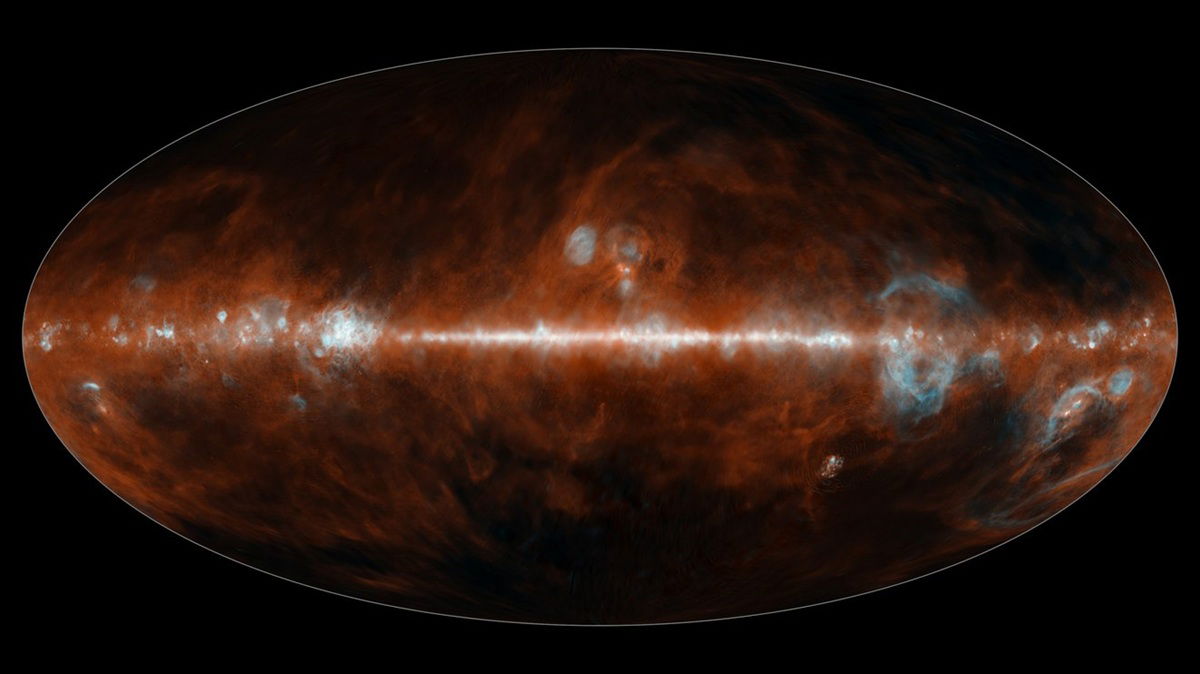
NASA has released the first complete infrared map of the sky from the SPHEREx mission. Credit: NASA/JPL-California Institute of Technology
The universe sometimes reminds us how small we really are.
A few weeks ago, NASA released the first images from SPHEREx, a new space telescope that has begun mapping the entire sky in infrared light. At first glance, the photo is simply beautiful. Glowing clouds, distant buildings, colors our eyes can never see. But behind the beautiful visuals lies a much bigger story.
SPHEREx will launch in March 2025 and will scan the sky multiple times over the next two years, collecting data on more than 450 million galaxies and more than 100 million stars in the Milky Way. Scientists hope the mission will help answer some of the biggest questions in modern astronomy, including how the universe expanded after the Big Bang, how galaxies formed, and where the water and organic molecules that support life actually came from.
In other words, it’s not just about beautiful photos. It’s important for us, including ourselves, to understand how it all started.
How SPHEREx scans the sky
Unlike famous telescopes that zoom in on tiny patches of space, SPHEREx acts like a patient surveyor.
The satellite follows a low polar orbit around the Earth, circling the Earth approximately 14 and a half times a day. As it moves from pole to pole, thousands of images are taken along a narrow strip of the sky. Thanks to the movement of the Earth around the sun, the strip moves slightly every day. About half a year later, SPHEREx once covered the entire sky. Then it starts all over again.
This slow and steady approach allows astronomers to build a fully layered map of the universe, including not only the bright, obvious ones, but also dust and faint structures hidden in the distance.
What’s particularly interesting about SPHEREx is the way it captures light. It observes 102 different infrared wavelengths, far beyond what the human eye can detect. Infrared light reveals chemical signatures trapped in cold dust clouds, distant galaxies, and frozen particles floating among stars.
There are also clever ways to keep the telescope cool. Instead of bulky cooling systems, SPHEREx uses a specially designed reflective shield that blocks heat from the sun and Earth. No liquid cooling or heavy equipment. Simple, efficient engineering works quietly in the background.
Please note that this is not a replacement for the James Webb Space Telescope. Webb provides stunning close-ups of individual targets. SPHEREx focuses on the big picture: the cosmic map that ties everything together.
Why scientists are searching for the origins of water and galaxies
One of SPHEREx’s primary scientific targets is something surprisingly real: the chemical building blocks of water and life.
Astronomers already know that clouds of dust and ice that drift between stars contain molecules rich in carbon and nitrogen. These materials will eventually become part of planets, atmospheres, and potentially living organisms. What is unknown is how widespread these compounds are and how they move through the galaxy over time.
SPHEREx could help explain how young solar systems inherit life-enabling components by measuring their distribution across vast regions of the universe.
This mission goes back a long way. According to modern cosmology, the universe experienced an incredibly rapid expansion period shortly after the Big Bang, a phase known as cosmic inflation. The tiny quantum fluctuations of that era later grew into stars, galaxies, and massive star clusters.
We have already seen traces of early ripples in the background radiation left over from the birth of the universe, but the evidence is not yet conclusive. There are still competing theories about how inflation actually worked.
SPHEREx gives researchers a new way to test these ideas by mapping the large-scale structure of the universe in three dimensions. By analyzing how galaxies are distributed and how their matter is assembled, scientists can narrow down which models make sense and which don’t.
This is the kind of research that rarely makes splashy headlines overnight, but slowly reshapes our understanding of reality.
Beautiful images now, great discoveries later
At the moment, the newly released images are mainly first-time images. Invisible infrared light is processed with false color to make it visible to the human eye, making scenes look dramatic and otherworldly.
NASA has not yet released detailed scientific conclusions from the data, which is completely normal. Sorting through this amount of information requires time, computing power, and careful verification.
Over the coming months and years, astronomers will transform these images into precise maps that will show how galaxies are arranged in the universe, how matter evolved over billions of years, and how the early universe shaped everything we see today.
There’s something quietly humbling about it. Light that left distant galaxies millions or billions of years ago can now be captured by small satellites orbiting Earth. Scientists are trying to piece together the story of existence itself from these faint signals.
SPHEREx is not designed to provide hot space photos or dramatic close-ups. Its strengths lie in perseverance, scale and consistency. It’s building a reference map that future missions will rely on for decades.
And this first release? It’s just an opening act. True discovery is still in progress.