

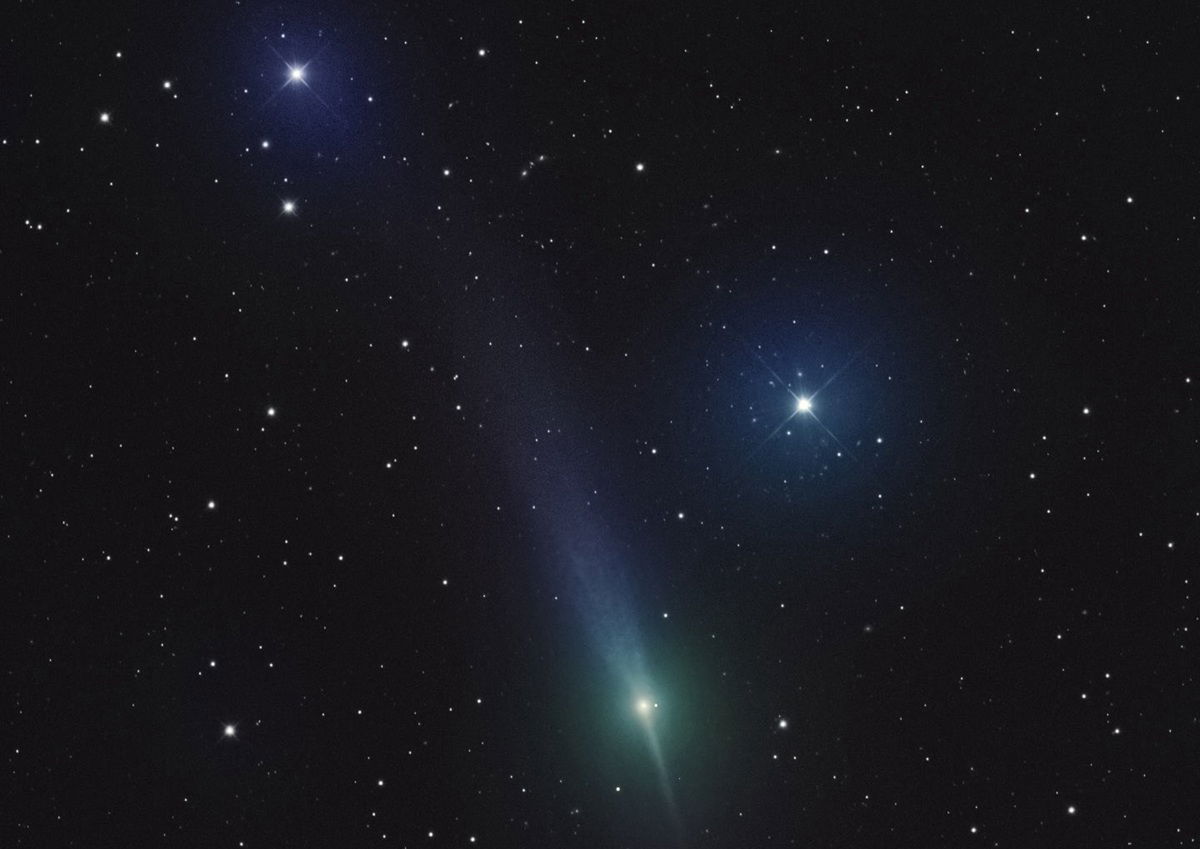
3I/ATLAS races across the night sky as the world’s attention returns to the mysterious object. Credit: X – Dr. Sebastian Woltmer @SeVoSpace
Just when many thought the mystery surrounding 3I/ATLAS was beginning to fade, a strange interstellar visitor has hit the headlines again. We have already reported on this strange object and the questions it has raised among scientists. And in recent weeks, the object has once again attracted international attention following a series of unexpected and quiet space defense exercises in several countries.
Officially, these exercises are described as routine training. But the timing is causing a lot of buzz among space analysts and defense experts. The coordinated nature of the training and participating countries suggests a growing concern about the unpredictable behavior of objects currently being tracked as 3I/ATLAS.
Europe was the first to move. The European Space Agency (ESA) has launched a large-scale three-day simulation of a full planetary defense system. For a system that is normally on standby, this was an unusually comprehensive test run, bringing together the rapid response modeling team, mission control hub, and ground-based monitoring network.
Immediately thereafter, Japan mobilized civilian authorities, defense forces, and private satellite operators to conduct its own impact simulation exercise. Then came the United States, and the Space Force suddenly brought forward a major tracking rehearsal originally scheduled for late 2026.
Even more remarkable is the involvement of countries that rarely publicize this kind of thing. Australia, South Korea and Brazil also reportedly participated in the exercise program and shared data between the newly launched surveillance systems.
According to reports, documents related to the training refer to preparations for tracking what are called “high-velocity objects with non-gravitational acceleration,” which many believe is a direct reference to the erratic movements observed by 3I/ATLAS.
Why scientists can’t fully explain 3I/ATLAS
This concern does not stem from fear of collision, as there is no suggestion that the object is on a collision course with Earth, but rather from how unusual its behavior appears.
Astronomers have observed strange features, including a hard tail jet pointing toward the sun, unexplained pulsations in brightness, and recurring changes in velocity that don’t fit traditional gravitational models.
One theory gaining new attention comes from respected astrophysicist Avi Loeb, who proposes that the anti-tail plane facing the sun may not actually be gas or debris at all. Instead, he suggests that 3I/ATLAS may represent a compact swarm of objects moving in formation.
Simply put, instead of a single interstellar object moving through space, several small companion stars may be moving along with it. It is located slightly closer to the Sun and tens of thousands of kilometers from any major celestial body. Observations since July seem consistent with that possibility.
If such a swarm existed, it would fundamentally change the way space agencies interpret and track phenomena. Monitoring a single object is difficult enough. Tracking multiple independent moving objects will require faster sensor systems, wider satellite coverage, and more agile response strategies.
A rare moment of global cooperation
Behind the scenes, this mysterious object also created something rarely seen: rapid cooperation between rival space powers.
Technologies that would normally be diplomatically sensitive, such as advanced surveillance satellites and deep-space infrared scanners, have been introduced with little resistance. ESA’s recently announced €22.1 billion expansion program passed through approvals with remarkable speed, while US procurement records show contracts for next-generation tracking platforms are accelerating.
At the same time, the International Asteroid Warning Network updated its protocols to allow the temporary use of classified surveillance data for objects labeled as “non-standard hyperboloids” (another expression believed to refer to the mysterious movement of 3I/ATLAS).
However, the object itself continues to baffle researchers. It slows down or accelerates unpredictably, spins erratically, or lights up for no apparent reason. All these behaviors are unpleasant and outside the existing model of nature.
As Dec. 19, the closest date of approach, approaches, officials insist there is no immediate cause for concern. However, the scale and synchronicity of global defense operations suggests that governments are treating this anomaly not as a threat, but as an unexpected stress test for planetary surveillance systems.
In the end, whether 3I/ATLAS turns out to be a rare astronomical wonder or just a misunderstood natural phenomenon, 3I/ATLAS has already accomplished something remarkable. It is about promoting closer cooperation among the world’s space agencies to fast-track defense readiness plans years ahead of schedule.
So far, this object remains exactly as it was when we first started reporting on it. Unanswered questions float silently across the planet, and the world is watching a little more closely than before.