

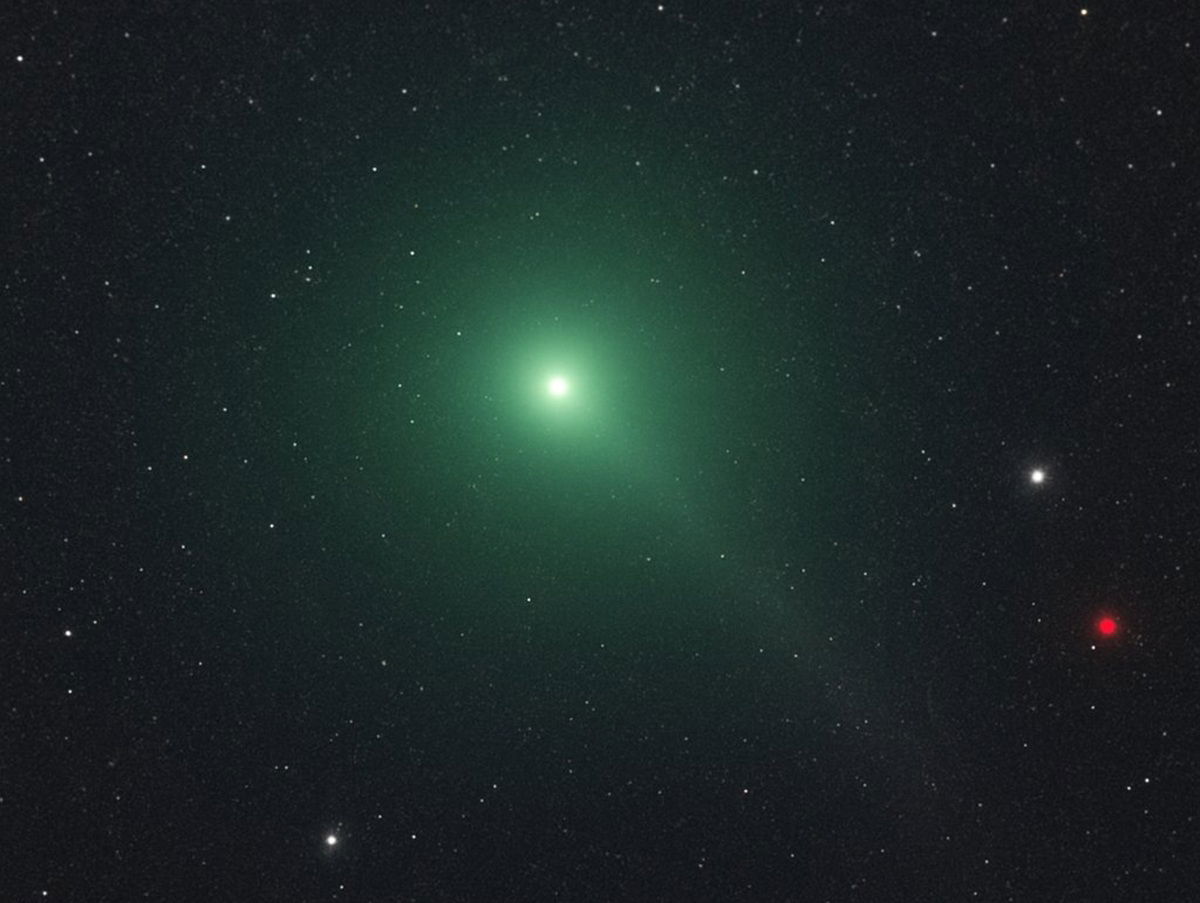
Interstellar visitor 3I/ATLAS captured in recent observations. Credit: X -SpaceTracker.space @Ammar1176708
Interstellar Visitor 3I/ATLAS is once again making headlines and getting scientists talking. Months after its discovery, the mysterious object from the far reaches of the solar system continues to amaze researchers, who now believe its surface may be dotted with erupting “cryovolcanoes,” a phenomenon rarely seen on this scale.
Earlier this year, 3I/ATLAS reached perihelion, the point of its closest journey to the Sun. As temperatures rose, astronomers observed large amounts of ice and dust ejected into space, creating spectacular jets that trailed behind objects like the tail of a classic comet. Even more interesting was the appearance of a “reverse tail,” a plume of material pointing directly at the sun, contrary to the usual pattern seen in comets.
This extreme activity led scientists to suspect a phenomenon far more dramatic than simple solar heating. It’s a type of cryovolcanism, in which frozen gas erupts in violent ejections similar to a volcano, but made of ice rather than lava.
Signs of a polar volcanic eruption to visitors from another star system
A research team led by Spanish scientist Josep Trigo Rodríguez of the Institute of Space Sciences studied the object in detail using images taken by the João Oro telescope at the Monsec Observatory in late October, when 3I/ATLAS activity was at its peak.
“We were all surprised,” Trigo Rodriguez said. live science. “For a comet that probably formed in a completely different planetary system, it’s surprising how similar the material on its surface is to what we see on objects beyond Neptune in our solar system.”
These distant objects, known as trans-Neptunian objects, frequently exhibit cryovolcanoes driven by internal heat sources that sublimate and eject frozen gas outward. The research team believes the same process may be playing out in 3I/ATLAS.
Their analysis suggests that carbon dioxide ice trapped below the surface may be reacting with minerals such as nickel and iron sulfides within the object’s core. This chemical interaction could generate the internal energy needed to eject the ice, sending jets of steam and debris into space.
There are still many mysteries about 3I/ATLAS
Despite the dramatic images, much remains unknown about this object. Even its size is still up for debate. Current estimates range widely, suggesting that the core may range from about 1,400 feet in diameter to about 3.5 miles in diameter.
What makes 3I/ATLAS so scientifically valuable is its origin. It did not form near our Sun, but in a completely different star system before washing ashore in our system. This will be a valuable natural time capsule from across the galaxy, containing clues about how planets and small bodies form under different cosmic conditions.
Astronomers want to make the most of this opportunity. 3I/ATLAS is scheduled to make its closest approach to Earth later this month, giving researchers another chance to collect more precise observations before the object heads deeper into the solar system and passes Jupiter in March 2026.
Why are scientists watching so closely?
Interstellar visitors remain incredibly rare, and each new discovery forces scientists to rethink long-held assumptions about how planetary systems evolve. According to Trigo Rodríguez and his colleagues, all objects like 3I/ATLAS appear to behave differently, introducing new puzzles that challenge existing theories.
“Interstellar objects continue to expand our understanding of how planetary systems form and how their chemical components change over time,” the research team said. “Each new visitor reveals unexpected properties that test our model.”
Researchers also point to the future of space exploration. Dedicated “interception missions” that can reach and sample these passing visitors could one day allow scientists to directly study real material from other star systems, a step that would take planetary science into truly uncharted territory.
But for now, 3I/ATLAS remains a distant yet dazzling mystery, its shimmering jets and supposed ice volcano reminding scientists and skywatchers that some of the universe’s greatest surprises can arrive directly from the depths of interstellar space without warning.