

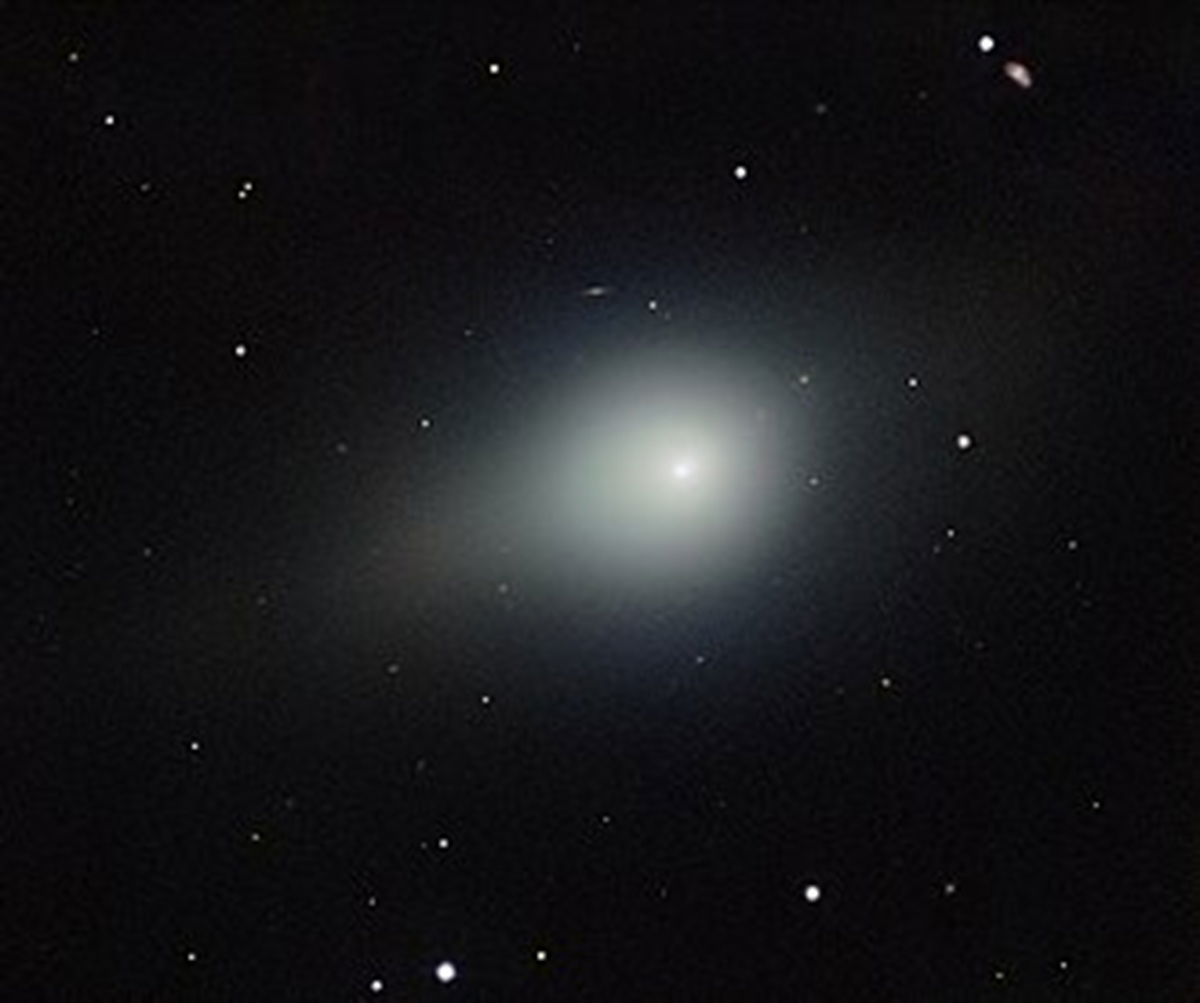
3I/Atlas, currently the closest interstellar visitor to Earth Credit: International Gemini Observatory/NOIRLab/NSF/AURA/B. Bolin
This is a story already well known to readers of globalnewsphere, and one that continues to arouse curiosity far beyond the scientific community. The mysterious interstellar visitor known as 3I/Atlas, which we previously reported on, is once again making headlines. This time, because its closest approach to Earth is occurring today, December 19th.
And while the object itself is not new, the questions surrounding it certainly are. Where did it come from? Why does it behave so differently than anything we’ve seen before? And what exactly does it tell us about the wider universe? 3I/Atlas continues to stir discussion, speculation, and interest among astronomers and space enthusiasts as new observations come in.
Visitors from beyond the solar system, and the rarest of them all.
To put things into perspective, 3I/Atlas is only the third confirmed interstellar object ever observed to cross the solar system. Unlike asteroids and comets that form around the sun, this object comes from a completely different place – a region of space that existed long before our planetary system was formed.
When it was discovered by the automatic observation system ATLAS in 2025, scientists quickly realized they were looking at something unusual. The trajectory clearly told the story. 3I/Atlas follows a hyperbolic path. This means that it is not bound to the Sun by gravity. It arrives from interstellar space, and once it passes through, it continues its journey, never to return.
What really stands out is its speed. Traveling at more than 210,000 kilometers per hour, 3I/Atlas is the fastest interstellar object ever detected. This velocity alone rules out the possibility that it originated within our solar system. Simply put, the Sun doesn’t have enough gravity to grab something moving that fast.
Where it came from remains one of the great unknowns. Scientists believe they formed around another star, perhaps during the chaotic early stages of a distant planetary system, and were then ejected by complex gravitational interactions. For now, these details remain frustratingly out of reach.
Strange brightness, strange tail, and unbecoming behavior
Since its discovery, 3I/Atlas has refused to behave like a “normal” comet, which makes it particularly interesting.
Astronomers have been tracking changes in its brightness, but the pattern hasn’t quite matched what they expected. Comets from our solar system typically grow brighter as they get closer to the Sun, as ice sublimates and gas and dust are released. However, in 3I/Atlas, the brightness changes are irregular, suggesting an unknown process is occurring.
Then there’s the tail. Most comets have tails formed by the solar wind that sweep cleanly away from the sun. The tail structures created by 3I/Atlas do not always follow that rule, and sometimes exhibit strange shapes and orientations that are difficult to explain.
Naturally, these observations gave rise to various theories. Most scientists prefer physical explanations, such as unusual volatiles, complex surface geometries, and unfamiliar release mechanisms. At the more speculative end of the spectrum, some float far more exotic ideas. But researchers are quick to stress that there is currently no evidence of anything other than a natural origin.
Why are scientists so careful?
Beyond its strange behavior, 3I/Atlas offers something truly unusual. It’s a direct glimpse into the material that formed around another star. Preliminary spectroscopic studies suggest that the surrounding coma, the cloud of gas and dust surrounding the object, may contain volatile compounds active at unusually large distances from the Sun.
If confirmed, this could show real differences in how small objects form in other star systems, and could help scientists refine models of planet formation far beyond our cosmic neighborhood.
Its speed also serves as a reminder that the Milky Way is not static. Planets and asteroids can remain bound to stars for billions of years, but objects like 3I/Atlas eject debris that wanders freely through interstellar space, showing how violently dynamic these systems can be.
This close approach allows agencies such as NASA and the European Space Agency to take the opportunity to collect as much data as possible and monitor it closely. Future missions and detection systems are already being planned to find similar objects earlier and study them in more detail.
For now, 3I/Atlas is only passing through, but its short visit has left an unforgettable impression. As we’ve seen, this is the kind of cosmic guest that reminds us of how small our corner of the universe really is, and why stories like this continue to capture our attention.